The Missing Stop Sign
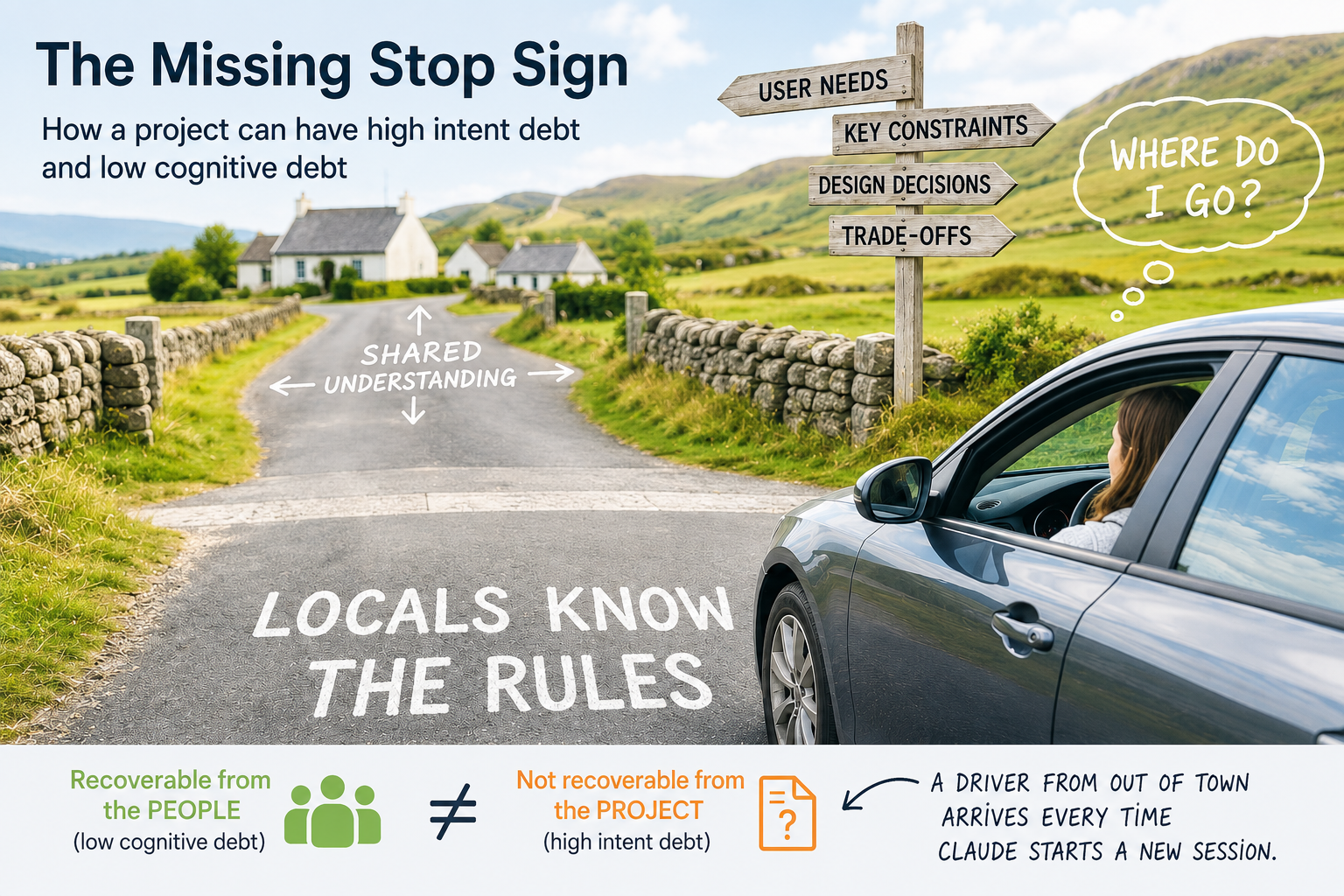
Throughout Ireland where I grew up, it was common to encounter intersections with no stop sign. The locals knew which car (or tractor!) had the right of way. And things were generally ok. Until a driver from out of town shows up!
I’ve been thinking about this a lot since publishing the Triple Debt model [1].
One of the most interesting questions I received was from a practitioner who wondered how cognitive debt and intent debt were separate constructs [2]. He also asked:
How can a project have high intent debt if everyone already understands what they're doing and why? Isn't the intent still recoverable even if it isn't written down?
At first glance, this seems like a contradiction. The missing stop sign analogy helps me explain why it isn’t.
When the Missing Sign Doesn’t Matter
Similar to how locals on a road may not need a stop sign to know what to do or to expect, a startup team in the early stages of a project may not need externalized knowledge about the project’s underlying intentions to work effectively.
The team may have an excellent shared understanding of user needs, key constraints, architectural decisions, and the rationale behind important trade-offs. They know what they are building, why they are building it, and how they got there.
At first, the system is relatively small and team members can communicate and interact with one another frequently. They don’t need “signs” because they share an understanding of where they are going and why. In triple debt terminology, they have low cognitive debt.
However, very little of their intent may be explicitly recorded. It lives primarily in conversations and shared experience. In Triple Debt terms, cognitive debt is low, but intent debt is high. Intent debt captures missing externalized information about user goals, discarded alternatives, assumptions, and the constraints that shaped key decisions. Such information cannot be recovered from the code, no matter how carefully you inspect it.
The missing sign creates no immediate problem because the knowledge is distributed across the team and easily recoverable through conversation. It is recoverable from the people, but not from the project itself. But the debt is latent and it isn’t an issue until a driver arrives from out of town!
A Driver Arrives From Out of Town with Every Claude Session
Before the widespread adoption of GenAI and agentic development, a new team member appeared relatively infrequently. Today, a driver from out of town may show up every time Claude starts a new session.
This situation also reminds me a bit of a 0% interest loan for a limited time period. The debt is there, but there is little immediate pressure to pay it down. In fact, there may even be short-term fiscal benefits from not doing so. Similarly, writing and maintaining intent artifacts takes effort, and that effort can be spent elsewhere. But eventually the interest-free period ends.
As time goes on and project complexity grows, memories may fade, and as new humans or agents join the project, the rationale behind important decisions becomes harder to recover (now the interest starts to accrue!). Agents in particular do not get to participate in “hallway” conversations and lack context and domain knowledge. The costs that were previously invisible begin to accumulate.
Why Agile Wasn’t Wrong
Another practitioner [3] in a private communication just this week reminded me that the need to record things, especially with speed and agents in mind, is not an argument for documenting everything, nor is it a criticism of Agile values.
Many successful teams rely heavily on conversation, collaboration, and shared understanding. In those situations, the missing stop sign may not matter at all (just as it didn’t to the Startup team example above). The challenge arises when the people, conversations, and context that make intent recoverable are no longer available.
AI agents make this challenge more palpable because they cannot easily participate in the informal social processes through which teams build and maintain shared understanding. The team can still be agile, but it has to pay attention to the information the agents and humans may need, when the driver arrives from out of town.
Next Stop
Missing signs are not the only problem. Sometimes the signs are present and accurate, yet people still get lost, especially when the road network has grown too complex to easily navigate. I will explore this in the next post.
References and Acknowledgements
[1] Triple Debt Model Paper. ACM Queue, May 2026. https://queue.acm.org/detail.cfm?id=3807966
[2] Discussion on Linkedin with Hugo Michaud.
[3] Private email conversation with Andrew Walenstein